Tuesday, May 1, 2012

At Fifth and Market


      An old woman sits at a window. A street runs below her.  It once shuttled fattened taxis past her building. Now buses, on natural fuel, run silent as fog.

      Men, one day, stopped wearing hats. Young people dressed without buttons. Taxis lost their hips. In its center, a mirror grew a round spot, like a coin fused to a fountain.

The demolition crew comes. Window, she thinks, you’ll give up before I do.

--MD

Photo by Bruce Barone

Thursday, April 26, 2012

Story on the Streets!

Dear Friends,

I'm very proud to announce that I am now part of new graffiti, a grassroots publishing project that gets literature out of our iPads and Kindles, off of our bookshelves, and onto the streets!  Want to get involved?  Go to http://newgraffitipublishing.com/ and check out its latest project, which marries my short story "Observatory" with artwork by Sarah Stone.  Visit the "Downloadable" page to print a poster-, letter- or postcard-sized image of "Observatory"--and post it wherever you think it will create something unexpected in the world!

And thank you, friends, for all you do to support writing, words, and creativity.  It is a joy to be part of this time and place with you.

MD

Friday, March 16, 2012

Six-Word Memoirs


From some of my freshman writers at Guilford College, who this week celebrated the power, mystery and impact of brief language:


Bills unpaid. Memories destroyed. Kick. Push. --Joe Able

Missed Period. Frightened Girl. Waiting Results.  --Kimberly Newton

What a jerk. Who's she?  Broken.  --Haley Andrews

Alone. Music blasting. Clenching the wheel. --Mollie Sewell

Darkness, black.  "PERMISSION."  Brightness, white. --Soobin Park

Time never dies, powerful, powerless . . .   --Issa Abdallah

Dread-head. Honor Student. F**k Stereotypes. --Devin Martin


Rock, air. Look down. Life, death.  --Elliot Freshwater 

Wednesday, March 14, 2012

Ask That

My husband, wonderful man, asks questions.  He collects stories.  He loves to listen to you.  He is not, by choice, a writer.  He's simply very curious, and attentive; and he would much rather speak to you about something moving and unexpected than about something dull and plainsong.  This is why, sitting down to dinner with my parents this week--we hadn't seen them in quite some time--he turned to my mother, and rather than intoning "pass the salt" or "let's have a moment of silence" or "how was your flight," he looked her in the eye and smiled and began with,

"Now.  Tell me a powerful moment from your childhood.  Don't think about it.  Just share the first thing that comes into your mind.  What is it?"

"The smell of tin."

Instantly.

After a moment's surprise, and a pause, she said again,

"Tin!  It's tin in the sun."

She went on:

"I'm very little.  This is the first house I can remember.  We had other houses before this one, but I don't remember them.  This one had a backyard, and my mother used to give me baths in a tub in the yard.  That's how children were bathed then."

"In the 1940's."

"Yes.  You took the tin tub outside, and you filled it with warm water . . .  And so when I smelled tin in the sun, I knew, I knew, I knew . . ."  Her eyes grew big, and she smiled the way a child does, with eyebrows going up as if the sun has risen in the sky for the first time.  "I was going to get a bath."

We all sat for a moment.  Smell of warm metal in the air.  Wet skin.  Quick as that.

Naked.

Fire.

Fork tastes sharper.

Mama doesn't look the same.

Sharper.

All for the question.  All for the asking.

You didn't know.  How could you?

Not what you thought you should: something else, my husband reminds me all the time.  Ask that.

--MD

Wednesday, March 7, 2012

Ghosts in the House

My room on the 19th floor of the Palmer House in Chicago faces the open air, and then a mirror of brick.  Out the window, across a gap of thirty feet, lies another wing of the hotel and another bank of windows, exactly like mine.  Each has sheer curtains overlaid with heavier ones; some are open; some are closed.  It's daylight outside, but gray.  One of those days when it feels like the moon is shining rather than the sun.  I turn and look at my room.  It is a very nice room.  I unpack my things and lay my books on the desk, then go out to dinner with friends.  When I return, late, and look out the window, I see that some of the rooms across from me are occupied, others not; some have their curtains wide open, others half drawn.  Two floors below me, brightly lit and curiously empty--not a piece of furniture in them that I can see--are two matching suites, each with its interior, connecting door slightly ajar.  Curtains half open.

On the second night, when I come back late to my room, the two empty suites below me are the only ones with lights still blazing, their nakedness exposed.  Everything else is darkness.  Something else odd: the two interior doors, each a mirror of the other, that had been slightly ajar are now wider open.  Well, probably work is being done in those two rooms, I tell myself.  I'd read in the hotel's history that in one hundred and thirty-three years--it is the oldest hotel in the country--its doors have never closed, and that to accomplish this any work on its floors must be done in stages.

The next day, at mid-day, I look out.  No one.  Nothing.  No movement.  Only the interior, connecting doors are a little wider open, as if they are growing braver.

On the third night the lights across and below me still burn steady and bright.  It occurs to me that someone must have decided these two rooms are better left empty and illuminated all the time.  I decide to go and see for myself.  But the Palmer House is a maze--1,600 rooms along white and gold halls that angle and twist and turn and wrap, so that you have to memorize your way, or else reach for the numbers like Braille.  I guess with my feet through the windowless quiet to where I think the rooms ought to be.  But I can't really be certain.  One narrow hallway does seem more deserted than the rest--none of the usual human debris, no Do Not Disturb signs clinging to the door knobs, no silver room-service dish covers littering the floor, no newspapers left untouched by secret lovers who have stayed, murmuring, in bed all day.

I go back to my room.  On the floor beside my bed is the book I'd left on the desk--I was certain I'd left it there, but maybe I had casually knocked it to one side as I went out.  I can be clumsy.  It lies face down on the carpet.  I pick it up and read:

The end of roving.  Though the heart be still as loving and the moon be still as bright.  Who would have thought it would come to an end so soon and so suddenly: the roving, the loving?

The next day, still gray, the snow begins to fall, as if the moon is being pawed at, called back.

--MD

Photo by Bruce Barone

Sunday, February 26, 2012

Waiting for the Bat

I am waiting for the bat.

In July, when we moved in, he was here.

He roosted in a corner of our screened attic window, wadded tightly, a velvet sock rolled into the lower right corner.  Sometimes he hung upside down, a hooded bulb.

Smaller than the paper lanterns hanging above him, the two empty wasp-nests.

Heavier than the dried leaves clinging in the spiderwebs.

Little brown bat.

I ran to the computer, looked him up.  Little brown bat.  That was his name.  Myotis lucifugus.  American little brown bat.  Male because solitary.  Sleepy because summer.  Works for four hours a day.  Flies and darts and catches.  But it's hard work, so he must rest much of the time.  I understand this.  I am a writer.
 
I fell in love.

Although I knew I shouldn't, I visited him daily. I have never lived with a bat, and I couldn't help myself.  I opened the door, ducked under the beam, crept toward the eave to stare.  Often I couldn't see his face.  It was hidden like a pea in a mattress.  When I could see it, it was small and strange and sharp, like something I should be comfortable with, but wasn't.

Little brown bat.

You are not allowed to kill the little brown bat.  He is protected.  When the exterminator came to the house, I made sure he knew.  There are some things, of course, you are allowed to do--like turn on the light three times a day to look at him--but you probably shouldn't.  Eventually I got a hold of myself, cut back like a smoker.  I came late at night, to see that he was gone, off hunting and catching.  I came in the morning, too, to see that he was back.  Every time, this terrible dread that he wouldn't be.

One may fret over a bat in the same way one frets over a lover or an idea.

"The little brown bat can be distinguished from the Indiana bat by the absence of a keel on the caclar and the presence of hairs on the hind feet that extend past the toes"--but I have no idea what this means, and I never got close enough, and I am vaguely resentful.  I may fret over it, but there are some things about a bat that should remain a mystery.

One day, late in fall, he didn't come home.  I scurried to my computer (I wasn't at my computer because there is always something you can do that is easier than writing, and looking at a little brown bat is one of those things).  A little brown bat must hibernate; he will fly south to find a mate, procreate, and seek a hibernaculum.  The beauty of that word made up, a little, for the loss.

The little brown bat is now, I assume, in a cave or an abandoned mine.  I too am drawn to caves and abandoned mines, and often go and live in them myself.  Sometimes, it's important to not even try to do anything.

Now I am waiting for the bat.

The computer says he might not be back until May.  It says nothing about whether the little brown bat likes to come back to the same roost, each year, it says nothing about ambition or variety.  The little corner where he slept is an empty yoke.  I don't go and look every day.  The last time, I mistook a fresh leaf for his body.

We wait for the moment imagination grows skin.

The wingspan of the little brown bat is eight to eleven inches.  Its membrane is dark brown.

What is the definition of little?


--MD

Sunday, January 22, 2012

Breathe

I want to remember this, and so I write it down.

Ted spoke today.  Ted doesn't often speak, but when he does, I listen.  Ted is eighty-six years old, a former chemistry professor--he and I have taught in the same classrooms--and an emigre who as a young boy was lucky enough to escape Hitler's killing machine.  During his long career, he taught both philosophy and science, and asked his students to think not just about how the world is bonded together, but about the very idea of bonding itself.  Ted has been retired now from teaching for many years; his hands are calm, and when he stands in a meeting to speak, he grips the back of the chair in front of him, if one is there.  If not, he stands and folds his hands over his belt, balancing himself from the inside.  His voice is soft, and it shakes slightly.  I should be clear: this is a bit like saying a tree shakes softly.  You don't confuse the delicacy at the edge with the welded rings of the core.

Today Ted stood and gripped the back of the chair in front of him, and this is the story he told, as nearly as I can capture his words, and his lilting voice:

"Today, I am thinking about meditation.  I have practiced meditation for a long time.  When I do so, I do it by focusing on a single sound, or a word; or else I will concentrate only on my breathing, my breath going in and out.  It is very important to me, this meditation, and I am very interested in meditation as a subject.

"But one day, not long ago, something began to happen to me.  I did not only meditate, but I began to think about meditation.  I began to read a few books on meditation, and then more and more.  Then, in the way of things, other people began to recommend books to me, and before I knew it I had quite a pile of books beside me, books about meditation and about other subjects that are also very important.  At about this same time, I became aware of a feeling--a feeling that I had not only so many things to read, but so many, many things to do, so many things that I must do.  I became overwhelmed by this feeling, and began to be quite unwell.  I went to my doctor, and my blood pressure was elevated--it had gone through the roof, in fact--and he put me on medication, and told me that we must do some ultrasound tests to check my internal organs.  At this point, I contacted my sons, who do not live near me--one of them lives in Tokyo, and has done so for a generation now--and I told them what was happening, thinking that I should let them know just in case something was going to take me off to the hospital.  My son in Tokyo wrote back to me right away, and this is what he said:

'I want you to go back to breathing.  I want you to think only about your breath.  Your body needs oxygen, and so you must take it in.  You must breathe in what you need, then you must breathe out what you no longer need.  You must breathe in the oxygen.  You must breathe out the carbon dioxide, which you no longer need but that something else--the plants--can use.  I want you to do this, and think in this way.  Breathe in what you need.  Breathe out what you no longer need.  And I want you to do this for twenty minutes.'

"It was amazing, the difference this made.  I realized, as I breathed this way, that the books that I had did not have to be read right now.  And that the things that I had to do, they did not have to be done, not right now.  When I went in later on for the ultrasound tests, nothing showed up on them at all.  My blood pressure was normal again, and the doctor congratulated himself that it was the medication that had done it.

"As I breathed in and out again, I remembered things that other people had taught me about breathing.  That, for instance, when we breathe in we have the chance to take in the suffering of the world, of a group or an individual, or maybe of the suffering we are immediately aware of . . . and then we have the chance to breathe out our compassion and love.  This memory came back to me as I breathed, as I concentrated on taking in what I needed.

"When I told my son about this memory that had come to me, he reminded me that the idea that we breathe in the suffering of others and breathe out our compassion for the world is a practice known as Tonglen, and that it has been practiced in India and in Tibet.  And I wasn't at all surprised to hear this.  And then I thought of something else."

For a moment I had trouble, as Ted's voice shook, understanding.  He was saying that he had been watching a television program earlier this week, and the program had been about . . .  I breathed, and then I decided that the word he had said was "god."  But that didn't sound right.  Then I breathed again, and I realized he had said the word "garden."  He was saying that he had been watching a program about gardens here in North Carolina, and that one, the Charlotte Botanic Garden, had a section devoted to a meditative garden, a space in which to sit and breathe.

". . . out what you no longer need," Ted ended, and sat carefully down, feeling the chair beneath him, while in the room around him the words god, garden and breath danced, forming an unstable compound.

--MD

Saturday, October 22, 2011

Kill Devil Hills

I awoke one morning less than a mile from where two human beings let go of a world and a word.  The world was sandy, sloping, then flat as a biscuit.  The word was no.

I'd just moved to North Carolina, and I wanted to see with my own eyes where the Wright Brothers had done it.  I pulled my husband out of our motel bed--the view outside the window was of a wall of dune, with the sun rising behind it--because I wanted to get there when the museum opened.  Ours wasn't the first car through the gate; it was the second.  I found my heart pounding.  Strange.  I'm no aviation buff, I know nothing about planes other than how to sit in them and ask for a blanket.  But my eyes pricked in the white light.  I could see the two wooden buildings, and the stone markers laying out the first attempts.  The museum building itself was disappointing--a mid-century scoop of white and orange sherbert thrown down on the tree-circled plain.  The trees weren't there when the Wrights came to Kitty Hawk for the openness and the solitude.  The sand they coveted for its soft landings has long since been replaced by grass, carefully planted to keep the dunes from shifting, from blowing clean off the map.  When we arrived, a lawn mower was plying up and down the site, stodgy as a cow.

We walked slowly through the museum, which wasn't all that bad on the inside.  The history of the flight was laid out on the walls, step by step.  We went from glass case to glass case.  Here were copies of the earliest letters, asking for information and advice from experimenters who had tried but failed.  Here was a notebook, and a propeller blade, and here the metal husk of an engine that had crashed.  The family that had arrived ahead of us wandered through and looked vaguely bored by all the detail; their little girl tapped on the glass in front of the engine block with her plastic dinosaur toy.  When her mother said, "Don't do that!" the little girl, true to the spirit of invention in the room, began tapping on the wooden frame next to the glass, instead.

"Isn't it wonderful," Orville Wright wrote, "that all these secrets have been preserved for so many years just so that we could discover them."

In the next, larger room were replicas of the Wright Glider and of the Wright Flyer.  A mannequin lay prone on the Glider but not on the Flyer.  True, the gliders were the brothers' first great successes, teaching them the rudiments of how to fly before they flew; before the gliders came the kites, which taught them the rudiments of how to steer before they steered.  Still, when Wilbur won the coin toss on December 14, 1903, and was the first to try the Flyer out on the sand, he misjudged badly and pulled the nose up too fast, making too steep an ascent.  The machine stalled and crashed before it went anywhere, and the men had to spend several days repairing it before they could try again.

I grabbed my husband by the sleeve and pulled him through the glass doors out the back of the museum.  There was no one on the distant field of sand, grass and stone.  We would have it all to ourselves.  I hurried toward it.  This was where they had done it.  December 17, at 10:35 in the morning.  It was 9:35 now, about the time they would have been getting everything into place.  We passed the replicas of their wooden camp-shed and hangar.  It was so cold, that winter, they'd had to sleep under five blankets with their caps, clothes and shoes on.  But the winds were steady, and that was all that mattered.  The sheds were rough and small and primitive.  We walked the distance it took to drag the Flyer from the hangar out to the launching rail.  The brothers needed the help of five men from the local lifesaving station, who had been signaled with a flag that it was time to haul the 640-pound Flyer into place.  I straddled the rail, which was used to get the machine rolling, and held my breath.  The two brothers had held each others' hands tightly for a moment, witnesses reported, before letting go.

I had my husband take a picture of me where the flights began.

We walked out to the first of the stone markers.  Orville.  120 feet, 12 seconds.  Wilbur.  195 feet.  Orville.  200 feet.  Wilbur.  Their father had named them after preachers he admired.  I choked up touching each stone, as though it had something to do with me personally.  Nonsense.  I wasn't even sand in 1903.

The longest flight was the last one that day, Wilbur's.  852 feet, 59 seconds.  When you reach this, the farthest marker, you can look back and see how little and yet how much it was.  Resting after that flight, the men had left the Flyer on the sand and were stunned and unable to save it when a huge gust of wind rolled it over and over and wrecked it.  They were done for that year.  But in the distance, on Kill Devil Hill, you can see the looming monument erected a quarter of a century afterward to that morning's glory.  From below, it looks disturbingly like a pedestal cigarette lighter.

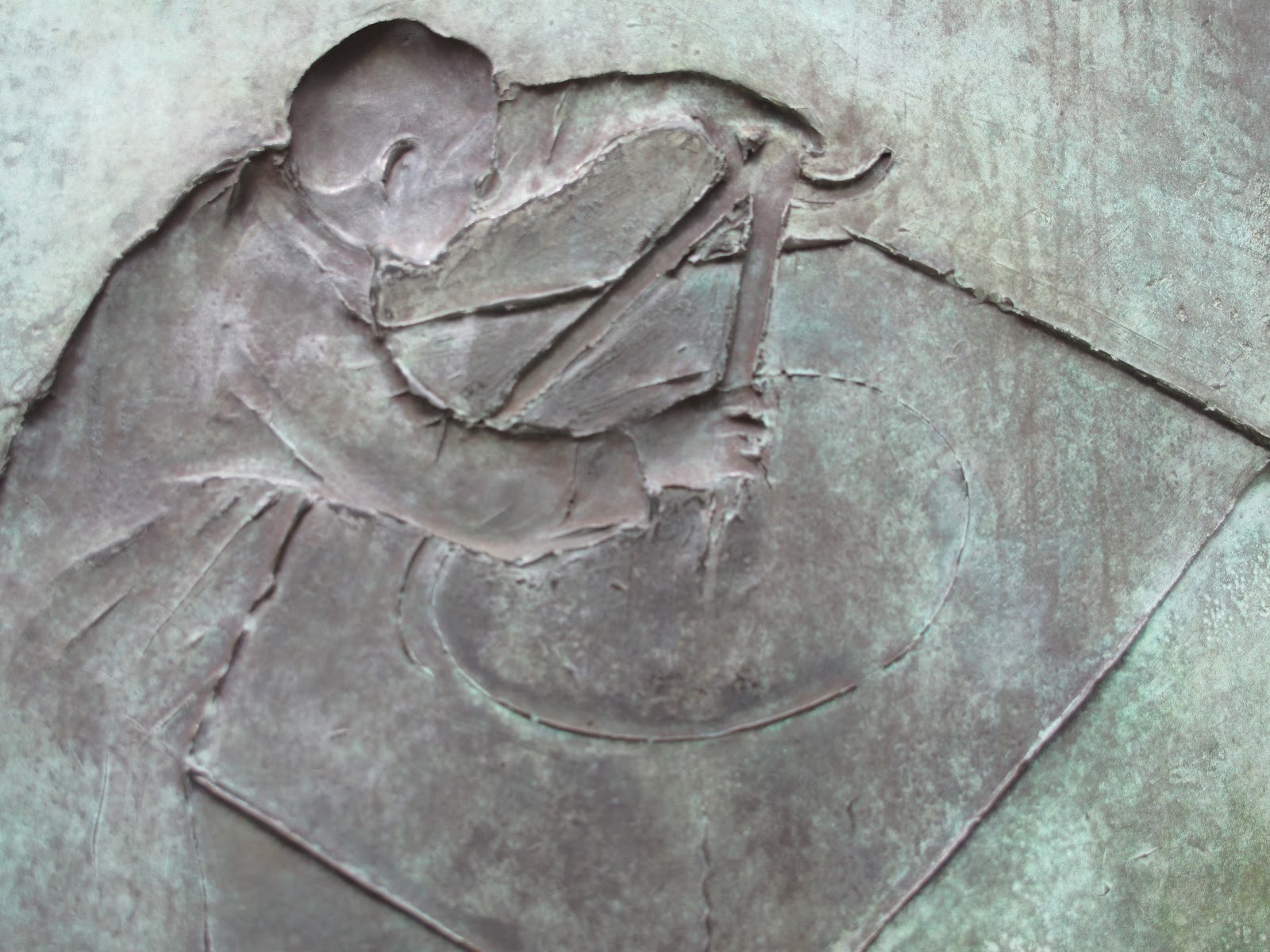
Up close, again, it isn't so bad.  Begun in 1928, the winged style is Art Deco, and the little green busts of "the bishop's boys" at the base bring it down to earth.  It looks strangely like a tomb, with its great bronze door decorated in panels showing the fall of Icarus and what looks like a god grasping blades in his hands.  The brothers aren't buried inside, but in Ohio, next to their mother, who was mechanically minded, and built toys for her children, who later built their own toys, and then bicycles.

I tell my husband we have to go back to the museum because I need something.  Badly.  I didn't know it until just then, but I need that picture of the moment the Flyer left the ground.  It isn't so much the machine itself that arrests me: it's Wilbur, standing off to one side, all of his weight on his forward leg as the Flyer leaves the earth--yet he's the one who seems lofted, out of body, as if he can't quite believe it, as if the whole thing, a decade's work and centuries before that, has taken him by complete surprise.  The photo was taken by a man who had never operated a camera before in his life.  The whole moment seems ridiculous, impossible.  Blink.  Over.

I ask the ranger on duty if he likes working at the museum.  He's from San Diego, and has only lived and worked at Kitty Hawk for five months.  He seems pleased but not overly enthusiastic.  Hey says you get to see cool things, and points to a military helicopter that has just landed behind the stone markers, bringing in a special group of visitors, although he can't say who.

"They were supposed to come a few days ago, but the wind was too strong."

In front of the camp-shed and hangar a group of ten geese have landed and settled into a ditch.  A tour bus from Mount Zion Church rolls up to the museum and opens its door.  Every human being who gets out of it is old and gray.  Wilbur Wright died at age 43, of typhoid; Orville sold their airplane business and lived for forty years without his brother.  He lived long enough to see the huge monument go up on the hill, and said of it that he was glad at least it wasn't "freakish."  Above the monument the moon has risen so high I can't get it into my camera's frame along with the obelisk.  I have to choose one or the other.  I choose the moon.

--MD

Friday, August 12, 2011

Humanity

In Boone, North Carolina, a three-mile track of narrow asphalt and iron bridges creek-hops and rolls past meadows, sports fields, the ruin of an old dam and the pale blue tanks of a sewage plant.  Start at the Armory, and you'll come first to the Equestrian Field.  It was empty as a Roman arena yesterday when I and my husband and our two dogs strolled by, its grass perfect, untouched, an oval platter.  The fence was freshly stained and smelled like biology class.  Joggers went around it, not through it, and passed us going in both directions.  A woman too heavy for her feet rested on a bench, then got up and tried again.  Another runner passed, and for a moment the air smelled of eucalyptus.  We aren't trees, but apparently we don't, from time to time, mind smelling like them.

At the first bridge we met a mother and her small daughter walking a tiny dog.  I asked what breed it was.  It looked like a pug had crawled inside the glove-box of a terrier.

"Oh," said the mother, "she's a Humane Society dog.  Great dog.  I think she'll find a good home."

"So you're fostering her?"

"No."  The mother stroked her daughters' curly hair, and the daughter, holding the leash, imitated her, bending down and stroking the dog's fur.  "We just like to stop by the Humane Society and take a doggie out for a walk.  They really appreciate it when you do that.  And it's so convenient, right here on the Greenway.  Except that now they're moving at the end of the month."

"That's a pity."

"Well no, not really.  We won't miss the sewage plant."

We waved and walked on, taking a path that led away from the main one and into the trees.  There we met a woman walking an old, gray-muzzled cattle dog off-leash.  She made a move to tether him, considerately, but we told her we didn't mind.  I asked where the trail came out, and she showed me where it joined the Greenway again.  The arm she pointed with was bright as a chalked sidewalk, tattooed with blue and yellow daises.  Her hair was wild, and it  looked as though she'd been lying on her side, dreaming.

At the power station was an old marker explaining how electricity came to Boone in 1915, lighting up a school and six residences.  I wondered what it must have been like to get that first surge.  The dam was nothing but old oak beams on the floor of the creek now, and the station a stone ruin that looked like a bombed church.  At the creek's edge we met two college students.  One was studying criminal justice, the other wanted to be a veterinarian.  Her, dog, a Blue Heeler-Aussie mix, was named Beau, and playfully fought our dogs to hold on to his own toy.

Around the next bend we started to smell sewage.  The breeze flushed the stink up our noses, that smell you're ashamed to recognize as so familiar, as your own, magnified and gone stale.  What a nuisance, we said.  And right along the Greenway, too.

"Although maybe we shouldn't fuss," my husband said, staring through the chainlink fence toward the cesspools.  "We're looking at what's probably the single greatest human achievement, ever.  It's what the whole of modern civilization rests on."

Right next door to the plant were the low, dilapidated roofs of the Humane Society.  It was easy to see why a move was underway.  The buildings and kennels were small.  The human stench too close.  Two young women came out leading a hulking white dog.  We stopped to say hello.  His name was Scout; he was a year-and-a-half old, and they had just adopted him.  It was sad, they said, how many dogs needed a home.  Then Scout pulled them off into the grass.  He had to use the bathroom.

The Greenway ends here.  Time to turn around and run the gauntlet of need and shame and power back to the arena and the Armory, with our dogs pulling ahead, sticking their noses in everywhere, judging how recent a mark was, and whether its architecture needed redoing.


Thursday, July 7, 2011

Wallfish

I learned a new word this week: to "wallfish" is to bury or conceal wires behind a wall by means of creating a hole in it, and then hooking or fishing the wires up through it.  It's a mechanism for hiding what's messy, or for trapping what's live and dangerous in a safe place.  I have Andrew to thank for my new word.  He came to my house this week to install cable television in a room where wires and plugs had been lying around scattered like kelp with teeth.  The first technician who'd come to the house hadn't wanted the job, but Andrew was up for it.

"Sounds like in-house," Andrew said about the other guy.  "They're always looking for excuses not to do things."

"He said my cable wasn't grounded," I told him, "and it couldn't be done.  Are you not in-house?" I gathered that meant he wasn't someone who worked directly for the cable company.

"No, ma'am.  I'm a contractor.  But the ground's no big deal.  I'll do it, and they can come by and ground it later."

"If it's safe for you?"

"It's no problem.  Long as there's no lightning."

"Have you ever been shocked?"

"Not by our wires, ma'am.  But by other people's, sure.  Like the phone company.  Somebody calls in while you're handling a line, and man, it can make your arm go numb." He grinned.  Mischievous.

Andrew was maybe nineteen, cleanshaven as a bootcamper, hair like a Beatle's.  His accent was thick and smooth, butter melting in his mouth.

"Andrew," I said while he got his monster of a drill bit out, "are you from around here?"

"No ma'am.  I'm from Ruffin, North Carolina.  Tiny place.  Only one stoplight.  It's got lots of space.  It's nice."

"You like it better there than here?"

"I do.  But it's good work here, even if they don't pay us as much as in-house."

"But I hope they pay you well," I said as he got ready to crawl under my house in the narrow and the dark and the heat, so he could fish the line up.

"Did till a few months ago.  Then they cut my pay about thirty percent."

"But why would they do that?"

"I'm not supposed to talk about the company.  But they're trying to get rid of us independents, is my guess."

He disappeared, and a few minutes later a line appeared miraculously through the sheetrock.

He told me, when we were on the same floor again, that sometimes customers expected him to work in rain and lightning.  He wasn't supposed to work in storms, but the week before a man had wanted him to run an aerial between two twenty-foot poles with a driving front blowing in.

"So what did you do?"

"I told him his line wasn't grounded," he laughed.  "Sometimes, you know, you gotta find an excuse."

I asked him if he'd gotten much training for all the unexpected things he had to do.  He said he'd gotten a full eight weeks, but now the company was pushing trainees out into the field after only three.  "It's crazy.  Half the time I still don't know how to do what I need to do.  I go real slow to make sure I'm doing it right.  I don't know how these new guys are managing."

"You don't seem slow to me."

He was already checking my cable connection on his laptop.  I jumped back.  His machine had crowed--a rooster's lusty cockle-doodle-doo!

He grinned again.  "It's just telling me there's a work order update.  It used to be a woman's voice.  But I changed her to a rooster."

"Why'd you do that?"

"It sort of wakes people up.  One time I was doing a job at a church, and there was this prayer meeting going on in the next room, and they all had to come out and see if it was inside, it sounded so real.  Plus, it's a great conversation starter with customers who don't want to talk to me."

"Sometimes they don't want to talk to you?"  What on earth did they do? I wondered. Just disappear while a boy jabbed live wire through a baseboard or danced up a telephone pole?

But Andrew seemed perfectly capable.  He didn't even need me to talk to him, I realized.  He just wanted me to.

"Some don't want to talk to begin with.  But it gets them going."

He covered the hole with a plate and gave me extra wire.

"Do I owe you anything?"

"Nope.  It's already paid."

It was getting late.  "I hope this was your last job of the day."

"It was."

"I hope you won't have to work on the holiday."  The Fourth was coming up.

"I do.  Saturday too."

"Well Jesus, I hope you get time and a half."

"We don't."

He grinned and reminded me what number to call if I had any problems.  And I couldn't for the life of me understand, I couldn't see, I couldn't guess, what lay behind that easy smile.  The rooster gave out a last call, then was shut up in the laptop.

--MD